
Gigabyte Passive Optical Network GPON
Installing a GPON (Gigabit Passive Optical Network) involves setting up a high‑speed internet, voice, and video over a point‑to‑multipoint fiber infrastructure that connects a central office to multiple end users. The process requires careful planning, adherence to ITU‑T G.984 standards, and precise fiber handling. It supports downstream speeds up to 2.4 Gbps and upstream up to 1.2 Gbps, making it a backbone for modern FTTH (Fiber‑to‑the‑Home) deployments.
High Bandwidth: 2.4 Gbps downstream, 1.2 Gbps upstream shared among users.
Triple Play Services: Supports voice (via ATM), data (via Ethernet), and video (via proprietary encapsulation).
Passive Infrastructure: No powered equipment between OLT and ONT, reducing maintenance costs.
Dynamic Bandwidth Allocation (DBA): Efficiently manages upstream traffic.
Security: Line encryption and Forward Error Correction (FEC) ensure data integrity.
GPON is a telecommunications access technology that uses fiber-optic cabling to reach the user. This fiber optic technology provides faster data transmission and reception through a single fiber, with a point-to-multipoint architecture, which allows home optical fiber (FTTH), or a building (FTTB)
Key Benefits
Definition: GPON (Gigabit Passive Optical Network) is a type of Passive Optical Network (PON) that uses fiber optics to deliver broadband services.
Standards: ITU‑T G.984 series (introduced in 2003, latest version 2010).
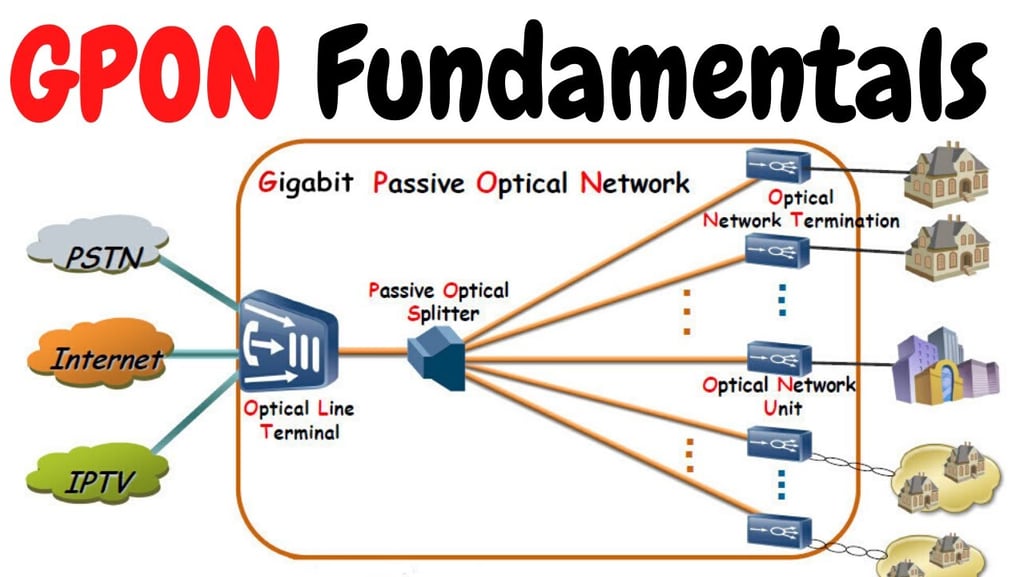
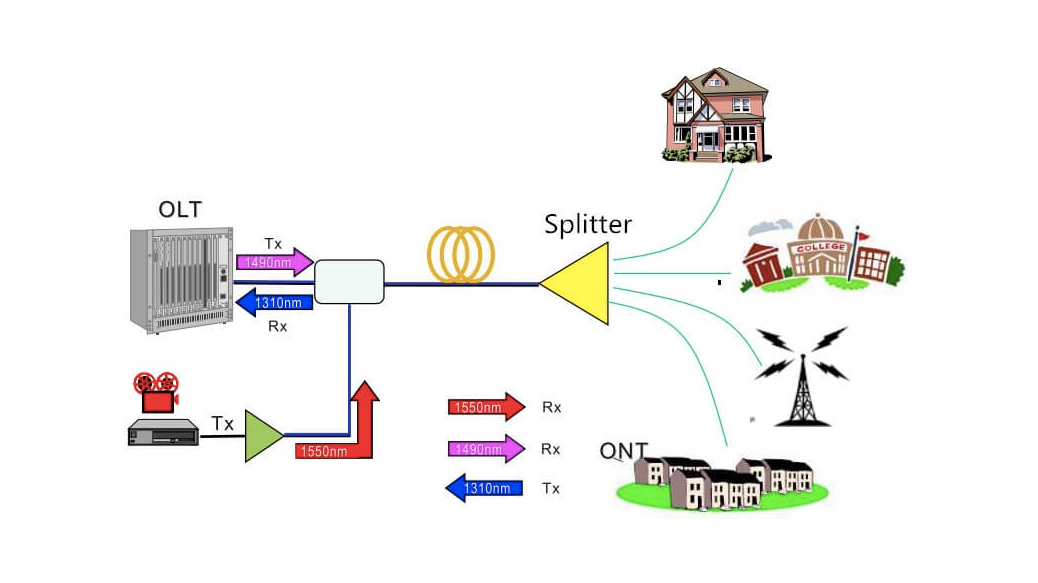
Topology: Point‑to‑multipoint, where one Optical Line Terminal (OLT) serves multiple Optical Network Units (ONUs) or Terminals (ONTs) via a passive Optical Distribution Network (ODN).
GPON is defined by ITU-T recommendation series G.984. GPON can be applied in many areas. In fiber to the home (FTTH) application, GPON is distributed via single-mode, simplex optical fiber connectors, and passive optical splitter typically using angled polish connectors (APC) to provide precision terminations. There are four main components in this GPON system: the optical line terminal (OLT), the transmitting media (cabling and components), the fiber optical splitter, and the optical network terminal (ONT).
Allows fiber connections up to 20 km between the OLT and the ONT. This is a great advantage because the old xDSL connections only reach a maximum of 5.5 km at a lower connection speed. This is the reason why users who live far from the switchboard used to suffer an interruption in connection with the speed contracted with their Internet provider.
It doesn’t need active intermediate equipment between the OLT and the ONT. It simplifies the deployment of fiber and allows much more straightforward and cheaper network topologies. Remember that splitters are passive elements.
Considerable reduction of costs for the operator because it allows sending many services at the same time through the same fiber connection. It can simultaneously send:
Voice (VoIP phone)
Data (Internet)
TV and video (Multicast). We can send digital television in high definition (IPTV), video on demand (VOD), analog broadcast by RF.
The operation and maintenance for the operators are also simpler because GPON has remote management of the user’s equipment (ONT), download updates, operating parameters, and more.